
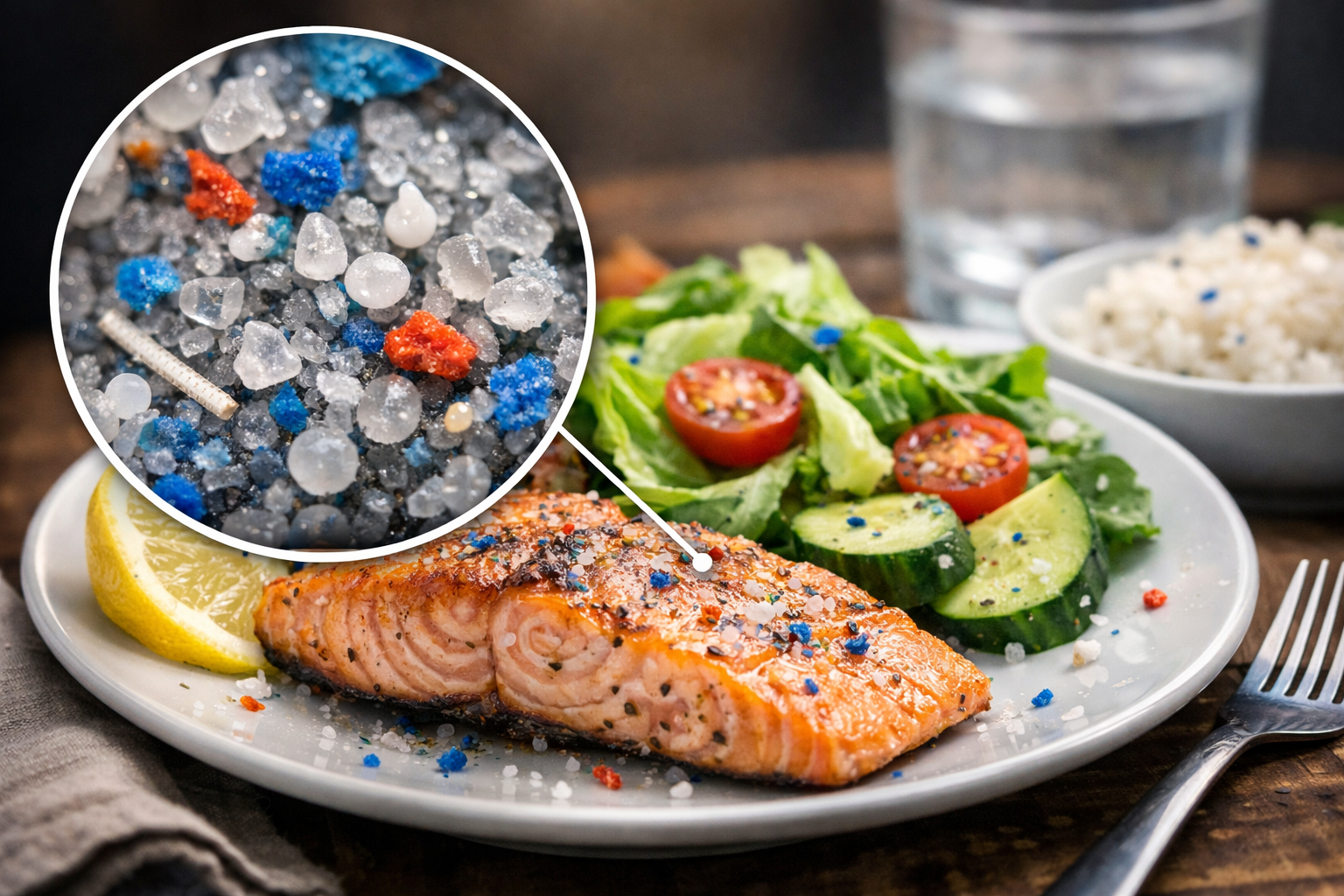
 Most people believe that eating healthy is simply a matter of choosing fresh, natural foods. Fish, tea, water, basic staples. Things we consume every day without hesitation. But what if these everyday foods are quietly exposing your body to something it cannot break down or remove?
Microplastics are tiny plastic particles that form when larger plastic products slowly break apart. Heat, sunlight and friction cause plastic to crumble into fragments so small they become invisible. These particles spread everywhere: through water, air and soil. Once they exist, there is no way to fully stop them from circulating. What makes microplastics especially concerning is what happens after they enter the body. Plastic does not dissolve like food. The human body has no natural mechanism to break it down. Research suggests that once microplastics are consumed, they can remain in the body for long periods of time, especially when exposure happens repeatedly through daily food and drinks.
Microplastics are not just inert particles. They often carry chemical additives and pollutants on their surface. These substances can be released once inside the body. Scientists are increasingly studying links between microplastic exposure and inflammation, hormonal disruption and long-term health risks. The danger is not a single exposure, but continuous accumulation over time.
The most disturbing part is how unknowingly this happens! Microplastics are not found only in heavily processed junk food. They are increasingly detected in foods people consider normal, safe and even healthy. Items that are part of everyday meals. And once you realize where microplastics are hiding, it becomes impossible to look at your food the same way again.
On the next page, you’ll discover the first everyday foods that already contain microplastics — and how they get there without you noticing!